By any measure what China is doing in Xinjiang is worse than what it is doing in Hong Kong, which admittedly is also awful. But western journalist identify with Hong Kongers in a way they don’t identify with the Uighur, Kazakhs and other Turkic minorities in Western China.

Showing posts sorted by date for query turkic. Sort by relevance Show all posts
Showing posts sorted by date for query turkic. Sort by relevance Show all posts
Wednesday, July 15, 2020
No one cares about Eastern Turkistan
The fact that Hong Kong is discussed throughout this article and Xinjiang is only mentioned in passing (and the Uighur people are not mentioned at all) says it all.


Saturday, July 15, 2017
Rinat Akhmetshin
Does anyone know the ethnicity of Rinat Akhmetshin, the shady former soviet intelligence agent who was mysteriously at that meeting between Donald Trump Jr. and the Russian attorney? News reports have referred to him as "Russian" but that's not an ethnic Russian name. His first name looks Turkic to me (I knew some Renats in Kazakhstan) and his last name is clearly Muslim-derived ("Akhmet" is how Ahmed gets transliterated into Russian, because Russian doesn't have an "h").
I'm not sure what the -shin suffix means, but it looks like a patronymic. In Kazakhstan, they used the Russian patronymic system. (So a male with a father named Akhmet would be Akhmetovich or maybe Akhmetov). But "-shin" is not a suffix I have seen before. Googling around, it looks like that might be used for some Tatar names (for example). So I wonder if he is Tatar.
ADDING: Just to be clear: I don't think Rinat Akhmetshin's ethnicity matters. I am just curious because of my interest in the peoples of the former soviet union in general. Whatever ethnicity he turns out to be, it won't tell us anything about his loyalties. Russia is much more multi-ethnic than most Americans appreciate. After growing up thinking of the entire USSR as "Russia" filled only with Russians, the ethnic diversity of the entire post-soviet space is one of my fascinations.
I'm not sure what the -shin suffix means, but it looks like a patronymic. In Kazakhstan, they used the Russian patronymic system. (So a male with a father named Akhmet would be Akhmetovich or maybe Akhmetov). But "-shin" is not a suffix I have seen before. Googling around, it looks like that might be used for some Tatar names (for example). So I wonder if he is Tatar.
ADDING: Just to be clear: I don't think Rinat Akhmetshin's ethnicity matters. I am just curious because of my interest in the peoples of the former soviet union in general. Whatever ethnicity he turns out to be, it won't tell us anything about his loyalties. Russia is much more multi-ethnic than most Americans appreciate. After growing up thinking of the entire USSR as "Russia" filled only with Russians, the ethnic diversity of the entire post-soviet space is one of my fascinations.
Wednesday, April 12, 2017
More Latin alphabet promises for Kazakh
That's a pretty bare-bones timeline. Essentially:
1. By the end of this year decide on a standard alphabet (not sure why they can't just go back to the Uniform Turkic Alphabet that they used between 1927 and 1940. Is there some problem with that alphabet as applied to Kazakh? If so, what is that problem?)
2. Start producing teaching materials in the new alphabet.
3. No later than 2025,profit! Kazakh should be written in Latin.
When I visited Uzbekistan in 2003, they were in year 8 of a 10 year transition period to move from the Soviet-imposed Cyrillic alphabet for Uzbek to a Latin alphabet. Aside from a few scattered holdovers, all the Uzbek street signs were in Latin script, but few people other than young people could read them. People would still write and print their own things in Cyrillic (I was handed a wedding invitation that I assumed was in Russian because of the script, but I later learned was in Uzbek written in Cyrillic. "Too many guests wouldn't be able to read it if it was in Latin" the local who told who identified the script explained). Even with all the Uzbek signs in Latin, older people, even older people who used Uzbek as their primary language, just relied upon the Russian-language signs--they could all read Russian because they had grown up as Soviet citizens. Now, 14 years later, things are probably better. But it was evident during my visit that 8 years was not long enough to make everyone understand a new script.
Maybe KZ will be better pulling it off than UZ was, but color me suspicious that in just 8 years Kazakhs will all be able to read their own language in Latin when they don't even know what the alphabet will be yet.
(Previous post about latinizing Kazakh (featuring a dead link!))
ADDING: Another article, but it really doesn't add many more details about the plan, because it doesn't look like there are any. But I do like the bit about how the timetable announcement was published in Kazakh but not Russian. Virtually all governmental announcements in KZ are done in Kazakh and Russian and the state run news source that originally published the story normally publishes in both languages.
Actually, the fascinating thing is Egemen Qazaqstan publishes its Kazakh edition in three different scripts--standard Cyrillic Kazakh, Latin Kazakh, and Arabic/Persian-script Kazakh. I didn't realize that publications in KZ were doing that. Arabic/Persian script is what the Kazakh minority in China use to write the language. I did not know that anyone currently wrote Kazakh in Latin.
1. By the end of this year decide on a standard alphabet (not sure why they can't just go back to the Uniform Turkic Alphabet that they used between 1927 and 1940. Is there some problem with that alphabet as applied to Kazakh? If so, what is that problem?)
2. Start producing teaching materials in the new alphabet.
3. No later than 2025,
When I visited Uzbekistan in 2003, they were in year 8 of a 10 year transition period to move from the Soviet-imposed Cyrillic alphabet for Uzbek to a Latin alphabet. Aside from a few scattered holdovers, all the Uzbek street signs were in Latin script, but few people other than young people could read them. People would still write and print their own things in Cyrillic (I was handed a wedding invitation that I assumed was in Russian because of the script, but I later learned was in Uzbek written in Cyrillic. "Too many guests wouldn't be able to read it if it was in Latin" the local who told who identified the script explained). Even with all the Uzbek signs in Latin, older people, even older people who used Uzbek as their primary language, just relied upon the Russian-language signs--they could all read Russian because they had grown up as Soviet citizens. Now, 14 years later, things are probably better. But it was evident during my visit that 8 years was not long enough to make everyone understand a new script.
Maybe KZ will be better pulling it off than UZ was, but color me suspicious that in just 8 years Kazakhs will all be able to read their own language in Latin when they don't even know what the alphabet will be yet.
(Previous post about latinizing Kazakh (featuring a dead link!))
ADDING: Another article, but it really doesn't add many more details about the plan, because it doesn't look like there are any. But I do like the bit about how the timetable announcement was published in Kazakh but not Russian. Virtually all governmental announcements in KZ are done in Kazakh and Russian and the state run news source that originally published the story normally publishes in both languages.
Actually, the fascinating thing is Egemen Qazaqstan publishes its Kazakh edition in three different scripts--standard Cyrillic Kazakh, Latin Kazakh, and Arabic/Persian-script Kazakh. I didn't realize that publications in KZ were doing that. Arabic/Persian script is what the Kazakh minority in China use to write the language. I did not know that anyone currently wrote Kazakh in Latin.
Friday, February 17, 2017
I'm a sucker for all things Turkic

Thanks to the always interesting Strange Maps blog, today I learned about Gagauzia. So I spent my lunch break learning about the mystery of the Gagauz people and where their language fits into the Turkic tree.
Wednesday, April 27, 2016
Friday, February 05, 2016
Rahmon
There's something a little funny about Tajikistan's President Emomali Rahmon's campaign to rid his country of names of Russian, Arabic, or Turkic origin. Yes, only names with purely Persian origin for President Rahmon!
Wednesday, July 29, 2015
Picking a nit
So I read this sentence in this article about how Turkish sympathy for the Turkic-speaking Uighurs is complicating Turkish-Chinese relations:
(Yes, I realize that one sentence does not really matter. This is not a criticism of the overall article or the point it was making. Rather, this is just a reflection of my own obsession with Pan-Turkism (particularly since 2010). For Example. In any case, if I can't pick a nit, what is the point of having a blog?)
Turkey, heir to the Ottoman Empire, has long seen itself as a protector of Turkic-speaking people across the arc of Central Asia — and that includes the mostly Muslim Uighurs in China’s western region of Xinjiang, where ethnic tensions and outbursts of violence between Uighurs and ethnic Han, the dominant group in China, have been rising because of what Uighurs say is official repression, though Chinese officials blame terrorist ideology.The first part of the sentence is odd, because the Ottoman Empire was not really a protector of Turkic-speaking people. The Ottoman Empire was a multi-ethnic empire that was Turkish ruled, but did not claim territory or justify its legitimacy based on ethnicity like the modern nation-state does. The Ottomans didn't always have good relations with their Turkic-speaking cousins in Central Asia either (e.g.). Pan Turkism (and the broad sympathy that comes with it for far-flung Turkic cousins like the Uighur) didn't exist until the last century of the Ottoman Empire and it is one of the forces that tore that country apart. It's not because modern Turkey is the heir to the Ottoman Empire that it sees itself as a champion of Turkic peoples around the world, it is because nationalism became the new grounds for national legitimacy when the Ottoman Empire collapsed. In that sense, pan-Turkic nationalism is a rejection of their Ottoman legacy, not the product of it.
(Yes, I realize that one sentence does not really matter. This is not a criticism of the overall article or the point it was making. Rather, this is just a reflection of my own obsession with Pan-Turkism (particularly since 2010). For Example. In any case, if I can't pick a nit, what is the point of having a blog?)
Tuesday, May 19, 2015
Cossack
Back in 2009, I tried to figure out the relationship between the "Cossacks" and the "Kazakhs." While the people themselves are not directly related, the names may be related. The Kazakhs named themselves "Kazakh" (really "qazaq") because it means the "free people" or "free wanders" in their own Turkic language. The Cossacks are Slavic, not Turkic, people. But when the Cossacks emerged as a Russian or Ukrainian speaking community in the 14th or 15th century, they were influenced by Turkic peoples who lived nearby (like the Crimean Tatars). The Cossacks adopted the name "Cossack" (казаки́), a Turkic-derived word meaning "freed men," just as they adopted some of the horse riding culture of their Turkic neighbors.
So anyway, I have all that in mind whenever I read about the Cossack bike gang in Texas. I imagine they borrowed their name from the Russian Cossacks (who in turn based their name on a borrowed Turkic term). Maybe they are invoking the idea of free riders (only with a motorcycle instead of a horse) they associate with the word "Cossacks", just as the Cossacks adopted the name Cossack to invoke the free riding Turkic horsemen. Or maybe the gang took their name from the soviet made Cossack brand motorcycle, thus taking a name from a brand that invoked the Cossack people who invoked the Turkic horse riders.

So anyway, I have all that in mind whenever I read about the Cossack bike gang in Texas. I imagine they borrowed their name from the Russian Cossacks (who in turn based their name on a borrowed Turkic term). Maybe they are invoking the idea of free riders (only with a motorcycle instead of a horse) they associate with the word "Cossacks", just as the Cossacks adopted the name Cossack to invoke the free riding Turkic horsemen. Or maybe the gang took their name from the soviet made Cossack brand motorcycle, thus taking a name from a brand that invoked the Cossack people who invoked the Turkic horse riders.
Monday, January 12, 2015
The Gülen School Rabbit Hole
This article sent me down a rabbit hole of googling about the Gülen school phenomenon.1 During our Kazakhstan year, Turkish schools were in every city and were quite prominent. We have friends who were graduates and Turkish secondary schools and Turkish Universities. Both seemed to have a good reputation. No one called them "Gülen schools", at least not to me. They were just "Turkish Schools"--a place where students followed a Turkish curriculum and learned Turkish in addition to the three languages that the government has mandated that every student must learn (Kazakh, Russian and English).
Anyway, my googling led me to this list of Gülen schools in the U.S. That, in turn, led me to the web site of Trubright Science Academy, a charter school here in Philadelphia that appears on that list. The list of Gülen schools appears to be compiled by people who don't like "the Gülen movement", so it is a little suspect. But Trubright is interesting just because there doesn't seem to be anything Turkish about it at all. While it brags about preparing students in "a world language" that world language is Spanish, with a "second World Language, Latin, [which] could be added in the future." There is no reference to Gülen, his movement, or anything Turkish anywhere on the site, at least not that I found. Its description of how kids are taught doesn't give anything that would raise any flags about pan-Turkism or Gülen's power struggles with the current Turkish regime. While the school could be sneaking that stuff in without not advertising it on the web site, it would be ridiculously obvious if they tried. I mean, some parent would be sure to comment if their inner city American high school student was being taught some lesson about the grand destiny of the Turkic nation. The closest thing to anything Turkish on the web site is the list of the members of the school's Board of Trustees, as the list happens to include a lot of people with Turkish names. (5 of the 6 Trustees, by my count)
The bottom line is, why is this school viewed as part of the Gülen movement at all? Other than the fact that the parent company seems to be funded by Fethullah Gülen or his followers, why does that matter? I mean, why is it viewed as part of Gülen's movement if there doesn't seem to be anything in the curriculum that would advance the group's alleged goals? Try as I might, I just don't see anything scary about it.
--------------------------------------------------------------
1- The article states that it is not clear what the Turkish schools "have done to offend Tajikistan’s aid-dependent and graft-prone government." I know very little about domestic politics in Tajikistan, but here's a guess: Tajiks are Persians not Turks. That is, unlike all the other former Soviet Central Asian Republics, the dominant ethnic group in their country does not speak a Turkic language. Tajikistan does have a lot of Turkic-speaking minorities--Uzbeks, Kyrgyz, Turkmen, Tatars--who might be receptive to the pan-Turkic message that Tajik authorities seem to believe is being fostered by Gülen schools. I could see how that would be viewed as a security threat to the leaders of a country like Tajikistan, an ethnic Persian outpost in a predominantly Turkic neighborhood whose territory is regularly depicted as being part of the pan-Turkic or pan-Turan dream country. (for example)
Anyway, my googling led me to this list of Gülen schools in the U.S. That, in turn, led me to the web site of Trubright Science Academy, a charter school here in Philadelphia that appears on that list. The list of Gülen schools appears to be compiled by people who don't like "the Gülen movement", so it is a little suspect. But Trubright is interesting just because there doesn't seem to be anything Turkish about it at all. While it brags about preparing students in "a world language" that world language is Spanish, with a "second World Language, Latin, [which] could be added in the future." There is no reference to Gülen, his movement, or anything Turkish anywhere on the site, at least not that I found. Its description of how kids are taught doesn't give anything that would raise any flags about pan-Turkism or Gülen's power struggles with the current Turkish regime. While the school could be sneaking that stuff in without not advertising it on the web site, it would be ridiculously obvious if they tried. I mean, some parent would be sure to comment if their inner city American high school student was being taught some lesson about the grand destiny of the Turkic nation. The closest thing to anything Turkish on the web site is the list of the members of the school's Board of Trustees, as the list happens to include a lot of people with Turkish names. (5 of the 6 Trustees, by my count)
The bottom line is, why is this school viewed as part of the Gülen movement at all? Other than the fact that the parent company seems to be funded by Fethullah Gülen or his followers, why does that matter? I mean, why is it viewed as part of Gülen's movement if there doesn't seem to be anything in the curriculum that would advance the group's alleged goals? Try as I might, I just don't see anything scary about it.
--------------------------------------------------------------
1- The article states that it is not clear what the Turkish schools "have done to offend Tajikistan’s aid-dependent and graft-prone government." I know very little about domestic politics in Tajikistan, but here's a guess: Tajiks are Persians not Turks. That is, unlike all the other former Soviet Central Asian Republics, the dominant ethnic group in their country does not speak a Turkic language. Tajikistan does have a lot of Turkic-speaking minorities--Uzbeks, Kyrgyz, Turkmen, Tatars--who might be receptive to the pan-Turkic message that Tajik authorities seem to believe is being fostered by Gülen schools. I could see how that would be viewed as a security threat to the leaders of a country like Tajikistan, an ethnic Persian outpost in a predominantly Turkic neighborhood whose territory is regularly depicted as being part of the pan-Turkic or pan-Turan dream country. (for example)
Monday, July 21, 2014
Not worse because they are the worstest, but worse because the others were not as bad to his particular religion
According to Chaldean Catholic Patriarch Louis Raphael Sako:
But if you're talking about which was worse for people in general (and not just Christians). I think the Mongols were worse than ISIS. At least based on what I remember from reading Empire of the Steppes one year ago.
The head of Iraq's largest church said on Sunday that Islamic State militants who drove Christians out of Mosul were worse than Mongol leader Genghis Khan and his grandson Hulagu who ransacked medieval Baghdad.Maybe he is right, at least if you're just measuring which was worse for Christians. Thanks to Nestorian Christian missionaries who went deep into Asia in the 7th Century, a significant number of the Mongols and Turkic tribes who invaded the Middle East were Christian. Doquz Khatun, the wife of Hulagu was Christian, and she is credited with sparing the Christians when the Mongols sacked Baghdad.
But if you're talking about which was worse for people in general (and not just Christians). I think the Mongols were worse than ISIS. At least based on what I remember from reading Empire of the Steppes one year ago.
Not that I'm saying ISIS is less than awful! It's just that the Mongol hordes are hard to beat, atrocity-wise.
Friday, February 07, 2014
Kazakh Eli
This is something that the citizens of Kazakhstan should decide, but to the extent anyone cares what an American who spent some time there and has a son with Kazakhstani citizenship thinks, I approve of replacing the "-stan" with a more Kazakh ending.
I think it would make Kazakhstan (or rather Kazakh Eli) more distinctive. In my experience, most non-Central Asians can't tell all the -stans apart. When I was there, a surprising number of acquaintances thought I was in Pakistan. To the extent that Kazakhstan wants to stand apart from the pack of post-Soviet Central Asian states (and also the South Asian -stans of Afghanistan and Pakistan), a name change would probably do a lot to help with that. It also would allow KZ to distance itself from "Borat." With the current name, it is impossible for any American publication to write an article about the country without bringing that film up.
In any case, the "-stan" suffix is originally Persian. Before the Turkic predecessors to the Kazakhs moved in, much of what is now Kazakhstan was part of greater Persia. Some Persian influences still remain and that is part of the country's history. But in the context of the government's overall project of Turkicicize (is that a word?) various place names, the change to Kazakh Eli does make some sense. (Although most name changes to date have been directed against Russian influences, not Persian. See, for example, Ust-Kamenogorsk/Oskemen, Aktyubinsk/Aktobe, and many other examples scattered around the country. Persian, at least, is viewed as more indigenous to Central Asia, even if it is not Kazakh.)
I think it would make Kazakhstan (or rather Kazakh Eli) more distinctive. In my experience, most non-Central Asians can't tell all the -stans apart. When I was there, a surprising number of acquaintances thought I was in Pakistan. To the extent that Kazakhstan wants to stand apart from the pack of post-Soviet Central Asian states (and also the South Asian -stans of Afghanistan and Pakistan), a name change would probably do a lot to help with that. It also would allow KZ to distance itself from "Borat." With the current name, it is impossible for any American publication to write an article about the country without bringing that film up.
In any case, the "-stan" suffix is originally Persian. Before the Turkic predecessors to the Kazakhs moved in, much of what is now Kazakhstan was part of greater Persia. Some Persian influences still remain and that is part of the country's history. But in the context of the government's overall project of Turkicicize (is that a word?) various place names, the change to Kazakh Eli does make some sense. (Although most name changes to date have been directed against Russian influences, not Persian. See, for example, Ust-Kamenogorsk/Oskemen, Aktyubinsk/Aktobe, and many other examples scattered around the country. Persian, at least, is viewed as more indigenous to Central Asia, even if it is not Kazakh.)
Friday, December 13, 2013
Майдан
Reading about the events in Ukraine, I have been wondering about the word "Maidan." The square in Kiev which is the center of protests is called "Maidan Nezalezhnosti" and is referred to as either "Independence Square" or "Independence Maidan" in most English language news reports. Those news sources use the word "maidan" in their English language articles because the protests themselves are now referred to as the "Euromaidan" protests, with the hashtag "#euromaidan."
"Maidan" (ميدان) is the word they use for "square" in Egypt. Other Arab countries that I have visited use a different word for city squares ("saa-Ha"/ساحة). So why do Ukraine and Egypt have the same word for "square"?
My guess was that "maidan" came from Turkish, considering that Egypt was once part of the Ottoman Empire and Ukraine was once ruled by various Turkic-speaking groups like Tatars and Kipchaks. Google translate says that "meydan" in modern Turkish means "square." And the word in Kazakh (Turkic language descendant from Kipchak turkish) seems to be "Audan" ("аудан"), which is kinda close.
So I win! Right?
No. AP says that everyone borrowed the word from Persian, although much of its travel seems to be via Ottoman Turkish.
"Maidan" (ميدان) is the word they use for "square" in Egypt. Other Arab countries that I have visited use a different word for city squares ("saa-Ha"/ساحة). So why do Ukraine and Egypt have the same word for "square"?
My guess was that "maidan" came from Turkish, considering that Egypt was once part of the Ottoman Empire and Ukraine was once ruled by various Turkic-speaking groups like Tatars and Kipchaks. Google translate says that "meydan" in modern Turkish means "square." And the word in Kazakh (Turkic language descendant from Kipchak turkish) seems to be "Audan" ("аудан"), which is kinda close.
So I win! Right?
No. AP says that everyone borrowed the word from Persian, although much of its travel seems to be via Ottoman Turkish.
Saturday, August 21, 2010
TürkBirDev!
since i got back from kazakhstan, i've been spending all this time visiting pan-turkic nationalist web sites. the sites are almost all in turkish, which suggests where the pan-turkic push is really centered. (another example: try switching the language from turkish to something else using the drop-down menu at the upper right of this page)
and then there's all the videos. i like the below one. even though it is in turkish, i can understand it pretty well:
my favorite part is the graphic that starts around 3:53 where an expanding EU, russian federation, china and america (which seems to own all of north africa, the entire middle east and southeast asia) surround and then gobble up the hapless un-unified turkic states. some of the other videos seem to want to include turkic speaking areas of russia, china, iran, iraq, the caucasus and eastern europe. this one implies that mongolia would be in on the deal (though mongolians are not turkic. i think my searches may have strayed into turanism).
anyway, i'm not sure why i continue to be so fascinated by this stuff. most of the pan-turkic videos are little more than an exhaustive list of every turkic ethnic group and flag, usually set to traditional turkish or martial music.
i'm also partial to all the cheesy wolf imagery. those pan-turkic folks really do like wolves.
and then there's all the videos. i like the below one. even though it is in turkish, i can understand it pretty well:
my favorite part is the graphic that starts around 3:53 where an expanding EU, russian federation, china and america (which seems to own all of north africa, the entire middle east and southeast asia) surround and then gobble up the hapless un-unified turkic states. some of the other videos seem to want to include turkic speaking areas of russia, china, iran, iraq, the caucasus and eastern europe. this one implies that mongolia would be in on the deal (though mongolians are not turkic. i think my searches may have strayed into turanism).
anyway, i'm not sure why i continue to be so fascinated by this stuff. most of the pan-turkic videos are little more than an exhaustive list of every turkic ethnic group and flag, usually set to traditional turkish or martial music.
i'm also partial to all the cheesy wolf imagery. those pan-turkic folks really do like wolves.
Sunday, April 04, 2010
nobody's business but the turks
i'm fascinated by the pan-turkism i've witnessed in my time here in kazakhstan. turkish influence a lot stronger than i expected, and it seems stronger than i remember from my time in uzbekistan in 2003. as i've mentioned before, turkish cafes dominate the local market here and turkish made clothes is a code-word for better quality. there are also turkish secondary schools and univerities, kazakhs study the turkish language, turkish companies are active throughout kazakhstan, the normal stigma against kazakhs marrying members of other ethnic groups doesn't seem to apply to kazakhs marrying turks, kazakhs can visit most turkic countries visa-free, i have met a handful of turks who live here in taraz and turkish money funds a lot of the local building projects.
the only country that holds a stronger cultural sway over kazakhstan than turkey is russia. but turkey is the clear second. this place is the point of intersection between the russian and turkish cultural sphere. i wonder if it's the same in the other turkic-speaking former soviet republics.
Thursday, January 07, 2010
mmmm turkey
i had read that turkey was working to build stronger ties with their long-lost turkic cousins in central asia before i came here. now that i'm here there are signs of it everywhere. there are turkish products, turkish schools, turkish things just keep coming up. plus the turks have almost cornered the market of cheap cafes. almost all of them serve turkish food and most have some turkey-related name.


Monday, October 26, 2009
the turko-islamic empire
strange maps always has good stuff, but this one is particularly interesting:
 (click to embiggen)
it depicts a new turkish led empire formed through the unlikely pan-turkic/pan-islamic alliance. and they went the overinclusive route. rather than including all the places that are both turkic and muslim, the mapmakers tried to include everywhere that is either turkic or muslim, although it fudges a few places.
for example, notice how areas with turkic-speaking majorities in russia get included, but areas with russian-speaking majorities in kazakhstan do not get excluded. and the map pushes the boundaries of the turco-islamic superstate liberally into east africa from the muslim majority areas along the indian ocean coast into areas that have clear christian majorities (like central kenya). it also squeezes out the christian majority areas along the atlantic coast of west africa (the southern bits of cote d'ivoire, ghana and nigeria). actually, the map-makers seem to be a little confused about africa in general. ethiopia is mislabeled as kenya, kenya is mislabeled as tanzania and tanzania is mislabeled as malawi. and i guess they didn't get the memo that zaire changed its name back to the democratic republic of congo back in 1997.
meanwhile, the mega-turk caliphate excludes lebanon, presumably because of its christian population, even though "there is general consensus that Muslims constitute a solid majority of the [lebanese] population". and then it doesn't exclude israel, where most of the population is jewish and not turkic speaking. (although no self-respecting caliphate map wouldn't claim all of israel/palestine). likewise, all of the predominantly catholic philippines is included (instead of just including the muslim-majority bits in the south)
the country also grabs all of mongolia even though it's not a muslim country and mongolian isn't a turkic language. it is altaic (the larger language family to which the turkic languages belong). but that's not a satisfying answer because it doesn't include other areas with (non-turkic) altaic languages, like korea, japan and northeastern siberia. it doesn't even include all of the places where mongolian is spoken, like northern china. and that's not because the map-makers are trying to be nice to china. they had no problem snatching the areas of western china where the turkic-speaking uighurs live.
as you can tell, i find maps of imaginary super-states to be pretty entertaining. what i don't find them to be is very threatening. every once in a while people flip out when they find a map of some overly ambitious caliphate, or greater aztlan, or whatever. you have to be pretty detached from reality to think those states are every gonna happen. cue jon stewart.
(click to embiggen)it depicts a new turkish led empire formed through the unlikely pan-turkic/pan-islamic alliance. and they went the overinclusive route. rather than including all the places that are both turkic and muslim, the mapmakers tried to include everywhere that is either turkic or muslim, although it fudges a few places.
for example, notice how areas with turkic-speaking majorities in russia get included, but areas with russian-speaking majorities in kazakhstan do not get excluded. and the map pushes the boundaries of the turco-islamic superstate liberally into east africa from the muslim majority areas along the indian ocean coast into areas that have clear christian majorities (like central kenya). it also squeezes out the christian majority areas along the atlantic coast of west africa (the southern bits of cote d'ivoire, ghana and nigeria). actually, the map-makers seem to be a little confused about africa in general. ethiopia is mislabeled as kenya, kenya is mislabeled as tanzania and tanzania is mislabeled as malawi. and i guess they didn't get the memo that zaire changed its name back to the democratic republic of congo back in 1997.
meanwhile, the mega-turk caliphate excludes lebanon, presumably because of its christian population, even though "there is general consensus that Muslims constitute a solid majority of the [lebanese] population". and then it doesn't exclude israel, where most of the population is jewish and not turkic speaking. (although no self-respecting caliphate map wouldn't claim all of israel/palestine). likewise, all of the predominantly catholic philippines is included (instead of just including the muslim-majority bits in the south)
the country also grabs all of mongolia even though it's not a muslim country and mongolian isn't a turkic language. it is altaic (the larger language family to which the turkic languages belong). but that's not a satisfying answer because it doesn't include other areas with (non-turkic) altaic languages, like korea, japan and northeastern siberia. it doesn't even include all of the places where mongolian is spoken, like northern china. and that's not because the map-makers are trying to be nice to china. they had no problem snatching the areas of western china where the turkic-speaking uighurs live.
as you can tell, i find maps of imaginary super-states to be pretty entertaining. what i don't find them to be is very threatening. every once in a while people flip out when they find a map of some overly ambitious caliphate, or greater aztlan, or whatever. you have to be pretty detached from reality to think those states are every gonna happen. cue jon stewart.
Sunday, March 20, 2005
what i've been up to
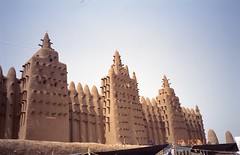
Grand Mosque of Djenne
Originally uploaded by upyernoz.
i spent much of yesterday doing practically nothing. actually, i did so little yesterday i almost feel like i accomplished something.
okay, that's not actually true. what i spent a lot of time uploading photos from my 2001 mali trip. i finally finished this morning. the full set is here, though you can only see the images with me in it if you have a flickr account and are already listed as my friend.
the upload, organization, and commentary took a really long time and i doubt if anyone other than me will even care. but it was worth it, i relived my entire 15 days in mali. plus now it's easier to subject my friends and relatives to boring holiday photos. i still have to upload and organize several other trips for the master plan to be complete, but i think i need to give it a rest before i'm ready to do tunisia
in the meantime, i'd like to thanks mustang bobby and michael for keeping golden boy occupied in the comments while i was mostly absent.
and finally, happy noruz to all my central asian readers. i don't always bring up holidays here, but i'm guessing that not many other sites are covering that one. the link i just created calls it the "persian new year" but it's actually celebrated among turkic people as well. it's probably the most widespread holidays in the world that is virtually unknown in the u.s.
Subscribe to:
Posts (Atom)